Marriage License in North Macedonia: 2026 Checklist
The full registry office document list — for citizens, foreign partners, and diaspora couples
Quick answer
For a civil wedding in Macedonia you need valid ID for both partners — the registry pulls Macedonian citizens' birth records itself. A foreign partner brings an apostilled birth certificate and certificate of no impediment to marriage, translated by a certified court translator. Book the registry office date as early as you can.
Key takeaways
- The registry office pulls Macedonian citizens' birth records itself — you don't need to bring one.
- A foreign partner needs an apostilled birth certificate and certificate of no impediment, both under six months old.
- A certified court translator must be physically present at the ceremony when one partner is foreign.
- A church wedding alone is not a legal marriage in North Macedonia — the civil ceremony is what counts.
- Summer Saturdays fill up fast, so book your registry office slot as soon as you have a date.
In this article
A civil wedding sounds simple — you show up, you sign, done. Except every couple who's actually been through the matична служба (registry office) will tell you the real work is in the paperwork: a missing apostille, a birth certificate that's a week too old, a name spelled differently on the passport than on the ID. This page is the checklist for that side of the wedding — the actual documents to get married in North Macedonia, what a civil wedding needs when both of you are citizens, and what gets added when one partner is a foreigner. For the rest of the planning timeline, see our phase-by-phase checklist and month-by-month wedding guide; this one goes deep on the registry office and everything around it.
What documents do you need for a civil wedding in North Macedonia?
You need valid ID for both partners — a national ID card or passport. The Bureau for Keeping Registry Books (UVMK), or the local registry office in the municipality where you want to marry, pulls the birth certificate for Macedonian citizens itself, so that's one less piece of paper you have to chase. What you do need to bring are certificates for special circumstances — a previous marriage, foreign citizenship, children from an earlier relationship — and the exact list is always worth confirming with the specific office, since practice varies by municipality.
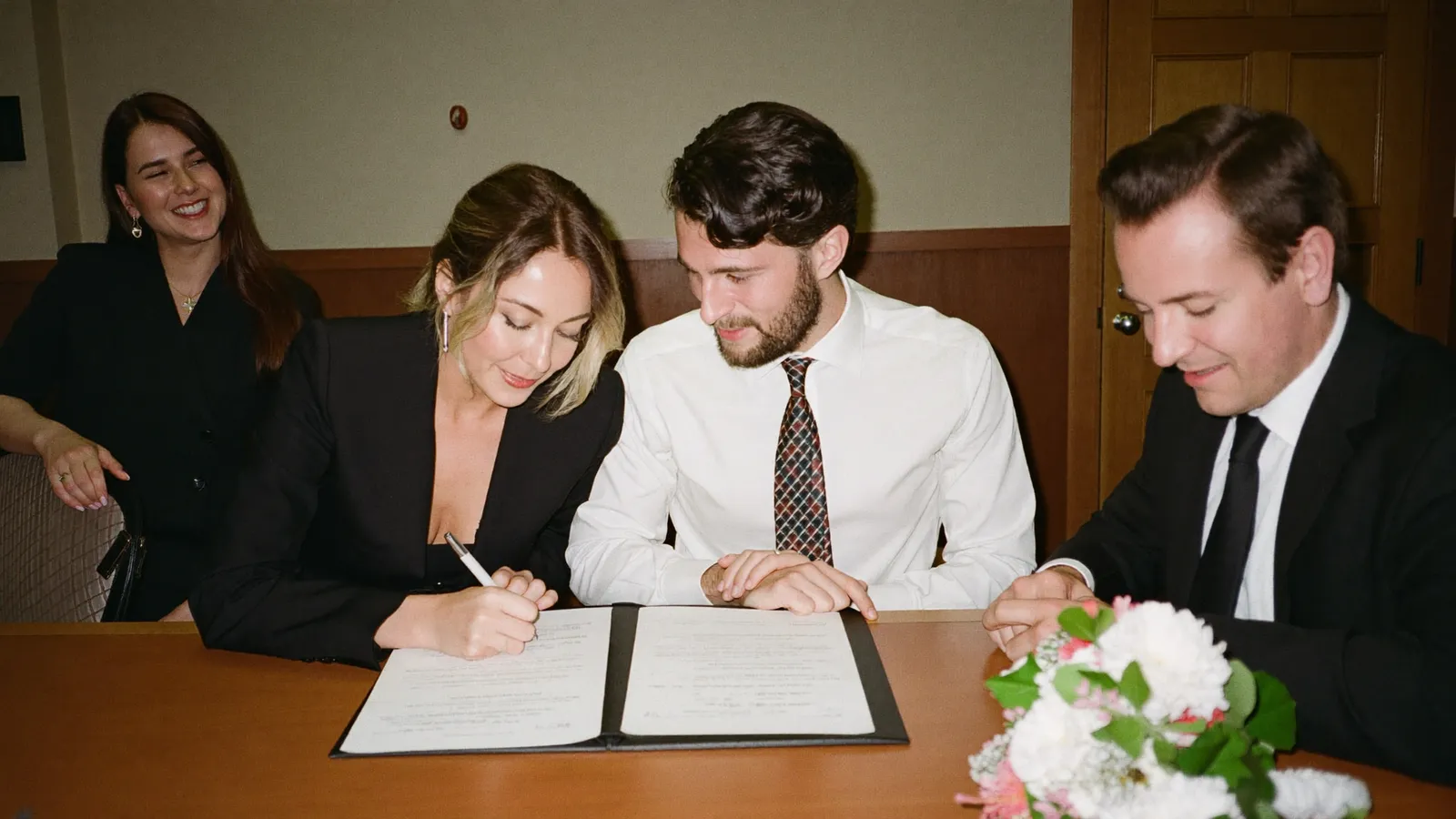
The process, roughly: you both show up in person at the registry office, file an application for a marriage certificate, and pay a 100 MKD administrative tax plus a 50 MKD fee into the Bureau's account, then get a date. On the day itself you sign in front of a registrar, together with two adult witnesses — a requirement under the Family Law — and walk out with a marriage certificate extract (извод од матичната книга на венчаните).
For a first marriage, some registry offices also ask for a certificate of attended marriage counselling from the Centre for Social Work. This isn't listed on the UVMK page itself — it appears in a Council of Europe / Ministry of Justice brochure — so ask your specific office about it in advance.
One thing that surprises first-timers: you're not required to marry in the municipality where you live. In practice, you can pick any registry office in the country, which a lot of couples use to line up the ceremony with the reception venue, even if home is somewhere else entirely.
Which documents do two Macedonian citizens need — and what changes with a previous marriage?
If you're both Macedonian citizens and neither of you has been married before, the list is short: valid ID for each of you, and that's really it — the office pulls your birth record on its own. If either of you has been married before, add proof that marriage ended, whether by divorce or the death of a former spouse.
| Situation | What you bring |
|---|---|
| Both citizens, first marriage | Valid ID or passport for each |
| Either previously married | The above, plus proof the previous marriage ended |
| Either has children from a prior relationship | Ask your registry office whether an extra parental status document is needed |
- Valid, unexpired ID or passport for both of you
- Proof the previous marriage ended, if applicable
- Full names, ID numbers and addresses for two witnesses
In practice, this is the easy half of the checklist. The part that trips people up most is the previous-marriage document — people assume the divorce "shows up in the system" automatically, and then find out at the counter it doesn't.
Plan your wedding in one place
Guest list, budget, checklist and a free wedding website. Built for couples in North Macedonia.
Start for freeWhat documents does a foreign partner need?
The foreign partner brings an original apostilled birth certificate, an apostilled certificate of no impediment to marriage (confirming there's nothing legally blocking the wedding), and a valid passport. Per UVMK, these two certificates typically can't be older than six months and must be translated into Macedonian by a certified court translator; if they contain letters like Y, W, X or Q, notarization is added on top.
- Birth certificate, apostilled, translated
- Certificate of no impediment to marriage, apostilled, translated
- Valid passport
- A certified court translator booked for the ceremony day itself
That last step is the one people forget: the translator doesn't just translate the paperwork ahead of time, they have to physically attend the ceremony, since the foreign partner makes a statement in a language the registrar likely doesn't speak. No translator present, no ceremony that day. Book them alongside your registry date, not after it.
The apostille itself is obtained in the country that issued the document, not in Macedonia — usually through a foreign ministry or a court, depending on that country's system. This matters for a lot of couples here: Albania (a member since 2004) and Kosovo (since 2016) are both parties to the Hague Apostille Convention, so documents from either country go through the normal apostille route. If the partner's home country hasn't signed the convention, the process runs through diplomatic legalization instead, which takes longer. Check this detail first, before you request anything else, since it shapes your whole timeline.
When and how do you book the registry office, and what about diaspora couples?
There's no legal minimum notice period, but Saturdays from May through October close out fast, especially in Skopje, Ohrid and Bitola. Book the moment you know your date — a few months out is ideal. If a partner is foreign, build in extra time, since the apostille and translation take a while and some countries are slow to issue them.
It's no coincidence that summer Saturdays are the most sought-after: according to the State Statistical Office, North Macedonia recorded 11,066 marriages in 2024, with August the busiest month.
If you live abroad and are only flying in for the ceremony, the procedure is identical, but the logistics are harder: gathering documents from another country and getting them translated locally eats up weeks, and you're not on the ground to solve last-minute snags. Book the registry slot before you book flights, not after, and carry a spare copy of every document — something always gets left at the airport or buried in a moving box.
One diaspora-specific wrinkle: if you already hold Macedonian documents issued abroad, say a birth certificate through a consulate, check whether it needs extra confirmation to be valid at the registry counter. Consular staff can usually tell you on the spot, which beats finding out something's missing once you're already back home with a limited number of vacation days left.
| When | What to do |
|---|---|
| As soon as you have a date | Pick a registry office and check available slots |
| 3–4 months out | Foreign partner requests the apostille and certificate of no impediment |
| 1–2 months out | File the application at the registry office; book a translator if needed |
| Final week | Confirm all documents are translated and both witnesses have valid ID |
Can the ceremony happen outside the registry office?
Yes — many registry offices let the registrar come to another location, like a restaurant, but it requires a separate written request and an extra fee. Per the UVMK price list valid from 1 February 2024, a ceremony outside the office costs 4,765 MKD on a weekday during working hours, 5,242 MKD after 16:30, and 10,484 MKD on a weekend or public holiday; if the venue is more than 10 km away, the fee increases by 100%. Check the current price list on uvmk.gov.mk before you plan, since prices change periodically. Once approved, you typically hear back within a few business days. Conditions vary by municipality, so confirm directly with your registry office before you promise the venue a registrar shows up — the venue booking and the registry approval need to move in parallel, not one after the other.
What do you get afterward, and how does a surname change work?
After the ceremony you get a marriage certificate extract (извод од матичната книга на венчаните) — the official proof of your marriage, and you'll need it for almost everything that follows: banking, health insurance, a child's paperwork. Changing your surname is entirely optional. The Family Law gives you four options: each of you keeps your own surname; one of you takes the other's; each of you adds the other's surname to your own; or one of you takes the other's and adds your own to it. Whatever you decide gets recorded on the certificate itself, and from there you go update your ID and passport with the new name — a separate errand at a different counter, worth scheduling the same week so you're not carrying two documents with two different names for longer than necessary.
What does a church wedding need, and is it enough on its own?
No, a church wedding has no legal standing by itself — in North Macedonia, a marriage only becomes legally valid through the civil ceremony at the registry office. Most churches therefore ask to see your marriage certificate, or at least a confirmed registry date, before scheduling the religious ceremony.
For the church ceremony itself you'll typically need a baptism certificate for both partners, a кум or кума (the best man or godparent figure who witnesses and signs at the religious ceremony), and in some parishes a pre-marriage conversation with the priest beforehand. The cost of a church wedding with one priest runs around 9,000 MKD, according to media reports on the Macedonian Orthodox Church's price list — always confirm the exact amount with your specific parish, since prices aren't officially published. The exact requirements — whether a conversation is required, how far ahead to book, whether the кум needs to share your faith — vary by church and parish, so check directly with yours.
- Marriage certificate (or confirmation of a booked registry date)
- Baptism certificates for both partners
- A confirmed кум or кума
- A pre-marriage conversation with the priest, if the parish requires one
The order of the two ceremonies is up to you — some couples handle the civil side quietly, with just the witnesses, then treat the church wedding as the main event in front of guests; others do both the same day or the same week. Either way, it's the registry office date that actually makes you spouses under the law, regardless of how big the wedding around it gets.
What are the most common reasons an appointment gets refused?
Appointments most often get refused or delayed over an expired document, a missing apostille, or a name mismatch between documents — a passport spelling something one way and a birth certificate another, often from transliteration or a name change not yet updated in the system. Foreign documents without an apostille or without translation from a certified translator get sent back almost automatically, since the registrar isn't permitted to accept them as they are.
Rules and local practice change, and the specific registry office where you'll marry always has the final word — this page is a practical starting point, not a substitute for their confirmation. Confirm the details with your office before you lock in a date.
What's the next step?
Once you have a rough date, add the registry office deadline to your wedding plan alongside everything else — it's the one deadline that's easy to lose between venue tours and dress fittings, and the only one with a legal consequence attached. Everything else, from vendors to the day-of schedule, you can organize through Kazhida.
Sources
- Marriage to a foreign national – Bureau for Keeping Registry Books (UVMK)
- Marriage registration and marriage certificate extracts – Bureau for Keeping Registry Books (UVMK)
- Marriage ceremonies outside UVMK premises – Bureau for Keeping Registry Books (UVMK)
- Registry offices raise wedding fees: a weekend ceremony now costs 10,500 denars – Vrabotuvanje.mk
- Family Law, consolidated text – Official Gazette of the Republic of Macedonia
- Table of parties to the Hague Apostille Convention – HCCH
- Marriages and divorces in 2024 – State Statistical Office
Frequently Asked Questions
What documents do you need to marry a foreigner in North Macedonia?
The foreign partner brings an original apostilled birth certificate, an apostilled certificate of no impediment to marriage, and a valid passport. Both certificates usually can't be older than six months and must be translated into Macedonian by a certified court translator, who also attends the ceremony itself.
Is a church wedding legally valid in North Macedonia?
No. A church or religious ceremony is a spiritual act with no legal standing on its own — marriage becomes legally valid only through the civil ceremony at the registry office. Most churches ask to see your marriage certificate, or at least a confirmed registry date, before they'll hold the religious service.
How far ahead should you book the civil wedding in North Macedonia?
There's no legal minimum, but Saturdays from May to October close out fast, especially in Skopje, Ohrid and Bitola. Book as soon as you have a date — a few months ahead is ideal. Add extra time if one partner is foreign, since the apostille and translation take a while.
What's different for diaspora couples marrying in North Macedonia?
The procedure is identical to any Macedonian citizen's, but the logistics are harder — gathering documents abroad and getting them translated locally eats weeks, and you're not around to fix a last-minute snag. Book the date before you book flights, and bring a spare copy of every document.
Does either partner have to change their surname after the wedding?
No, changing your surname is entirely optional. The Family Law gives you four options: each of you keeps your own surname, one of you takes the other's, each of you adds the other's surname to your own, or one of you takes the other's and adds your own to it. Whatever you choose gets recorded on the marriage certificate, and from there you update your ID and passport, which is a separate errand.
What if a document is in a different alphabet or language?
Any document not in Macedonian, or in a script the registrar can't read directly, needs translation by a certified court translator, and sometimes notarization on top. This applies to documents from any country, regardless of alphabet. Confirm the exact requirement with your specific registry office before you book.
Keep reading

The North Macedonia Wedding Checklist, Phase by Phase
A complete wedding planning checklist for North Macedonia: tasks by phase, who owns each one, registry office documents and the vendor deposit schedule.
· 9 min read

Wedding Invitations in North Macedonia: When and What to Send
When to send wedding invitations, what to write on them, what printing costs in 2026 and how to collect RSVPs without chasing guests by phone.
· 9 min read

Wedding Planner in Macedonia: App or a Pro?
Wedding planner in Macedonia — app or a professional? Real 2026 costs, when you truly need a planner, and a 7-step DIY walkthrough.
· 9 min read