Wedding Planner in Macedonia: App or a Pro?
When you actually need a person, and when a free app covers it

Quick answer
A wedding planner in Macedonia can mean two different things — a professional you pay to run the logistics, or a free planning app like Kazhida that holds your checklist, budget and guest list in one place. Most couples marrying in their own city manage fine with an app. You pay a planner when the logistics genuinely outgrow what you can track — Ohrid, 300+ guests, both partners living abroad.
Key takeaways
- "Wedding planner" means both an app and a person — decide which you need before you price it out.
- A full-service planner runs 5–10% of the budget, typically 30,000–180,000 MKD (€500–2,900) in our model.
- Day-of coordination alone costs 20,000–50,000 MKD (€325–815) and is the best value for most couples.
- Ohrid weddings, 300+ guests, or a couple living abroad are the real cases for hiring a professional.
- A free app like Kazhida covers your checklist, budget, guests and seating — it won't call the restaurant for you.
In this article
If you've googled "wedding planner Macedonia," you're probably not sure whether you need a person or an app — fair enough, because the phrase covers both here. Some people mean a professional who runs the whole thing for a fee, others mean a tool where you enter your guests and your budget yourself. Both exist, both work, but not for the same couple or the same wedding. This piece splits it apart: what each one actually does, what a planner costs, when you genuinely need one, and how to plan it yourself with a free app if that's the road you're on.
What does "wedding planner" actually mean here?
Locally the phrase covers three different things — a professional organizer working for a fee, a coordinator bundled free into a restaurant's package, and a planning app like Kazhida. The difference isn't the label, it's who does the work — a person, or you, with a tool's help.
A professional planner is a hired individual or small agency who signs vendor contracts, sits in on meetings, and is physically present on the wedding day. A restaurant's coordinator only works within that venue — they know the kitchen and the hall, but they won't source a photographer if you don't already have one. An app doesn't negotiate with anyone — it just holds the whole picture in one place so nothing slips through the cracks.
When someone types "wedding planner mk" into Google, they're usually after one of two things — a planner's price, or a free way to handle it themselves. This piece answers both.
What does a professional wedding planner actually do?
A professional planner takes over some or all of what you'd otherwise be doing by hand for weeks — choosing and negotiating with vendors, tracking the budget, building the day's timeline, and being on-site on the wedding day to react when something goes sideways. You're paying for their time and their contact list, not for magic.
In practice, the work splits into two tiers:
- Full-service planning. The planner is involved from the start — recommends venues, negotiates prices, tracks payment schedules, coordinates photographer, music, decor and transport, and is physically there the whole day so you're not the one fielding phone calls in your dress. This is the tier that costs 5–10% of the budget.
- Day-of coordination. The planner steps in one or two months before the wedding, picks up what you've already booked, builds the final timeline and shows up on the day so you don't have to answer your phone mid-ceremony. This is the cheaper option, and honestly, it's the one most couples actually book these days.
What a planner doesn't do is make taste decisions for you — they execute decisions, they don't make them.
Plan your wedding in one place
Guest list, budget, checklist and a free wedding website. Built for couples in North Macedonia.
Start for freeHow much does a wedding planner cost in Macedonia?
Full-service planning typically runs 5–10% of the total wedding budget, which in our model works out to 30,000–180,000 MKD (€500–2,900). Day-of coordination alone is considerably cheaper — 20,000–50,000 MKD (€325–815). These are our estimates from 2026 offers, not the result of a survey — no Macedonian planner publishes prices — so treat them as a guide rather than a fixed price list.
The cost depends on how big the wedding is and how much you've already sorted out yourself. A couple with 250 guests and several vendors to coordinate will land toward the top of the range; a smaller wedding with the venue already booked usually falls lower.
Put that number in context against the whole wedding: a 150-guest wedding runs 510,000–1,370,000 MKD (€8,300–22,300) in total, and a 250-guest one runs 740,000–1,820,000 MKD (€12,000–29,600). The restaurant, food and drinks make up roughly 40–55% of that budget in our model. A planner, even at the top of the range, is a smaller slice of the bill than people assume — but it's still a real cost to plan for up front, not tack on at the end.
When do you actually need a paid planner?
You need a paid planner when the logistics genuinely can't be handled from a distance or under real pressure — not because you're "busy" in some general sense, but because a specific circumstance calls for it. Four situations actually justify the cost.
- A wedding in Ohrid (or any city that isn't yours). You can't call ten restaurants in Ohrid from Skopje on your lunch break and know which one is actually good. A local planner already knows which venues have Saturday slots in season, which company buses in groups of guests, and which photographers know the local spots.
- 300+ guests. Past a certain number, day-of coordination stops being something one couple can track alongside everything else happening that day. That many people means more tables, more vendors, more places something can go wrong at once.
- Both partners living abroad. If you can't be there in person for meetings, tastings and venue visits, someone needs to be your eyes and ears on the ground. That's literally the job when you're on another continent.
- A wedding spread across two days with more custom traditions. Weddings with multiple events — an engagement gathering, the wedding itself, a separate day for the parents — have more moving parts than a single-day celebration, and coordinating between them takes someone tracking both days.
If none of that sounds like you, an app and a bit of organization is probably all you need. And yes, a kum or kuma (the best man / godparent figure with real responsibilities here) can help fill some of that gap for free — but they're doing you a favor, not running a business.
What does a free app cover, and what doesn't it?
A wedding planning app gives you the structure — checklist, budget, guests, a calendar of deadlines — free, and on your phone whenever you need it. What it doesn't do is negotiate, show up in person, or fix a problem in real time on the day itself.
Kazhida, for instance, is a free couple's planner with a phase-by-phase checklist, a budget tracker in denars, a guest list with RSVP collection, a seating planner, a calendar of deadlines and deposits, and a vendor marketplace where you search and message restaurants, photographers, bands, florists and salons directly, by city. You also get a free wedding website with RSVP to share instead of printing invitations.
That's the real difference — the app organizes you, a planner acts on your behalf. Neither replaces the other if your actual problem is that you don't have time to physically attend meetings — no app anywhere fixes that.
Wedding planner: app vs. professional — quick comparison
| Situation | App is enough | Hire day-of coordination | Hire a full planner |
|---|---|---|---|
| Wedding in your own city, up to 200 guests | ✅ | ||
| Wedding in Ohrid or another city, you live there | ✅ | ||
| 300+ guests | ✅ | ✅ | |
| Both partners live abroad | ✅ | ||
| Two-day wedding with multiple events | ✅ | ✅ | |
| Restaurant already has its own coordinator | ✅ | ||
| Little free time, but you want your own vendor picks | ✅ |
Where does the planner fit in the total budget?
The whole wedding, not just the planner, is what really drives the budget — and the restaurant is the biggest line item by far. For context, a 150-guest wedding runs 510,000–1,370,000 MKD (€8,300–22,300) in total, and a 250-guest one runs 740,000–1,820,000 MKD (€12,000–29,600).
| Item | 150 guests | 250 guests |
|---|---|---|
| Total budget | 510,000–1,370,000 MKD (€8,300–22,300) | 740,000–1,820,000 MKD (€12,000–29,600) |
| Venue, food and drinks | 40–55% of budget | 40–55% of budget |
| Full-service planner (5–10%) | 25,500–137,000 MKD (€415–2,225) | 37,000–182,000 MKD (€600–2,950) |
| Day-of coordination only | 20,000–50,000 MKD (€325–815) | 20,000–50,000 MKD (€325–815) |
Deposits usually run 20–30% for the venue and 20–50% for the photographer and band — budget cash for those early, not in the last month. For the full booking timeline, see the 12-month wedding planning guide.
How do you plan a wedding yourself, step by step?
If you've decided an app covers your wedding, here's the order that actually works — not a wish list, a sequence of decisions where each one depends on the last.
- Agree on budget, guest count and month. These three numbers determine everything else. Enter them into your budget tracker as soon as you have them.
- Build a two-column guest list. Yours, theirs. Merge them so you see where the number jumps before you start calling venues.
- Book the restaurant 9–12 months out if you want a Saturday in June, September or October. Search by city in the vendor marketplace and message a few at once.
- Lock in a photographer and band 6–9 months before the date. They book up almost as fast as venues for the good dates.
- Send invitations through your wedding website instead of printing them — RSVPs come in automatically and you'll know the exact headcount when the venue asks for it.
- Build the seating chart once 70–80% of guests have confirmed — don't leave it for the last week.
- Check your deadline calendar weekly in the final two months — that's when deposits and final confirmations start stacking up.
What mistakes do people make on both sides?
The most common mistake for couples going it alone is starting without a budget — and finding out the restaurant costs more than they thought only after they've already booked it. The most common mistake for those who hire a planner is the opposite — paying for full service when what they actually needed was day-of coordination.
Another common one is trusting memory for the guest list — there's always a forgotten relative who "obviously" was coming. And both planners and DIY couples make the same mistake with vendors — agreeing on a verbal promise without a written confirmation of the deposit and date, which turns into a problem in exactly the month when there's no room left to fix it.
What's your next step?
If you've read this far and you're leaning toward "the app is enough," don't wait until next month to start — you can enter your budget and guest count today. Search for vendors by city and category directly on Kazhida, and keep everything else — checklist, budget, guests, seating and your wedding website — organized in one place in your wedding plan.
Sources
Frequently Asked Questions
What is a wedding planner and what does it cost in Macedonia?
A wedding planner is either a professional who runs the whole logistics for a fee, or an app that organizes your tasks for free. A professional costs 5–10% of the wedding budget — in our model, 30,000–180,000 MKD (€500–2,900) — for full service, or 20,000–50,000 MKD (€325–815) for day-of coordination only. Apps like Kazhida are free.
Do I need a planner if the wedding is in Ohrid?
If you or most of your guests live somewhere else, it's worth considering. A local planner in Ohrid already knows which venues have Saturday slots in July, which company can bus guests in, and which photographers know the locations. If you're from Ohrid or nearby, you already have that local knowledge and an app is enough.
Does a wedding planning app really replace a planner?
For organizing and tracking, yes. The app gives you structure — what to do and when, how much you've spent, who RSVP'd. For negotiating with vendors, showing up in person and solving a problem in real time on the day, no, that takes a person. Most couples end up combining an app for themselves with a day-of coordinator.
How far ahead should you book a wedding planner?
Book a planner six to nine months ahead, especially for a Saturday in June, September or October — good planners are already reserved by then. For day-of coordination only, three to four months out is usually enough.
Do restaurants already include a planner in the price?
Many restaurants in Macedonia include a wedding coordinator as part of the venue package, at no extra cost. They handle the flow of the evening and talk to the kitchen and the band on the night, but they work with the vendors the venue already uses. If you want your own choices for photographer, music or decor, that coordinator won't source them for you.
What's cheaper — a full planner or planning it yourself with an app?
The app is free, a planner costs real money — but it's not just a price question. If you have the time and live in the city where you're marrying, the app saves you 30,000–180,000 MKD without losing control. If you're short on time or the logistics are genuinely complex, a paid planner often earns that money back through better vendor terms.
Keep reading

Wedding Invitations in North Macedonia: When and What to Send
When to send wedding invitations, what to write on them, what printing costs in 2026 and how to collect RSVPs without chasing guests by phone.
· 9 min read
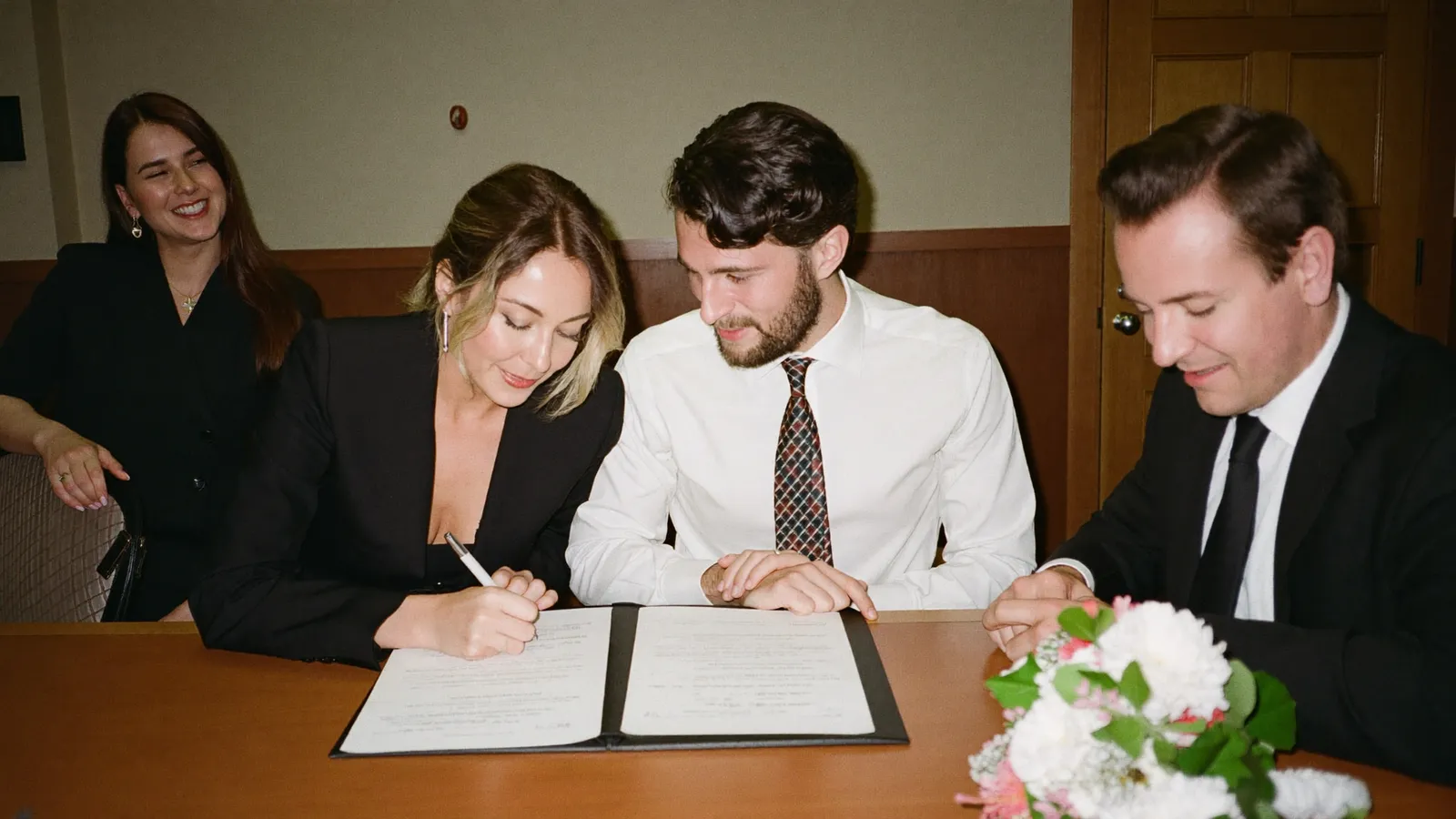
Marriage License in North Macedonia: 2026 Checklist
Get a marriage license checklist for North Macedonia: the documents to get married, what changes for a foreigner, and when to book.
· 10 min read

The North Macedonia Wedding Checklist, Phase by Phase
A complete wedding planning checklist for North Macedonia: tasks by phase, who owns each one, registry office documents and the vendor deposit schedule.
· 9 min read