Macedonian Orthodox Wedding Ceremony: 2026 Guide
Documents, the church fee, wedding candles, crowns and the dates the church does not marry
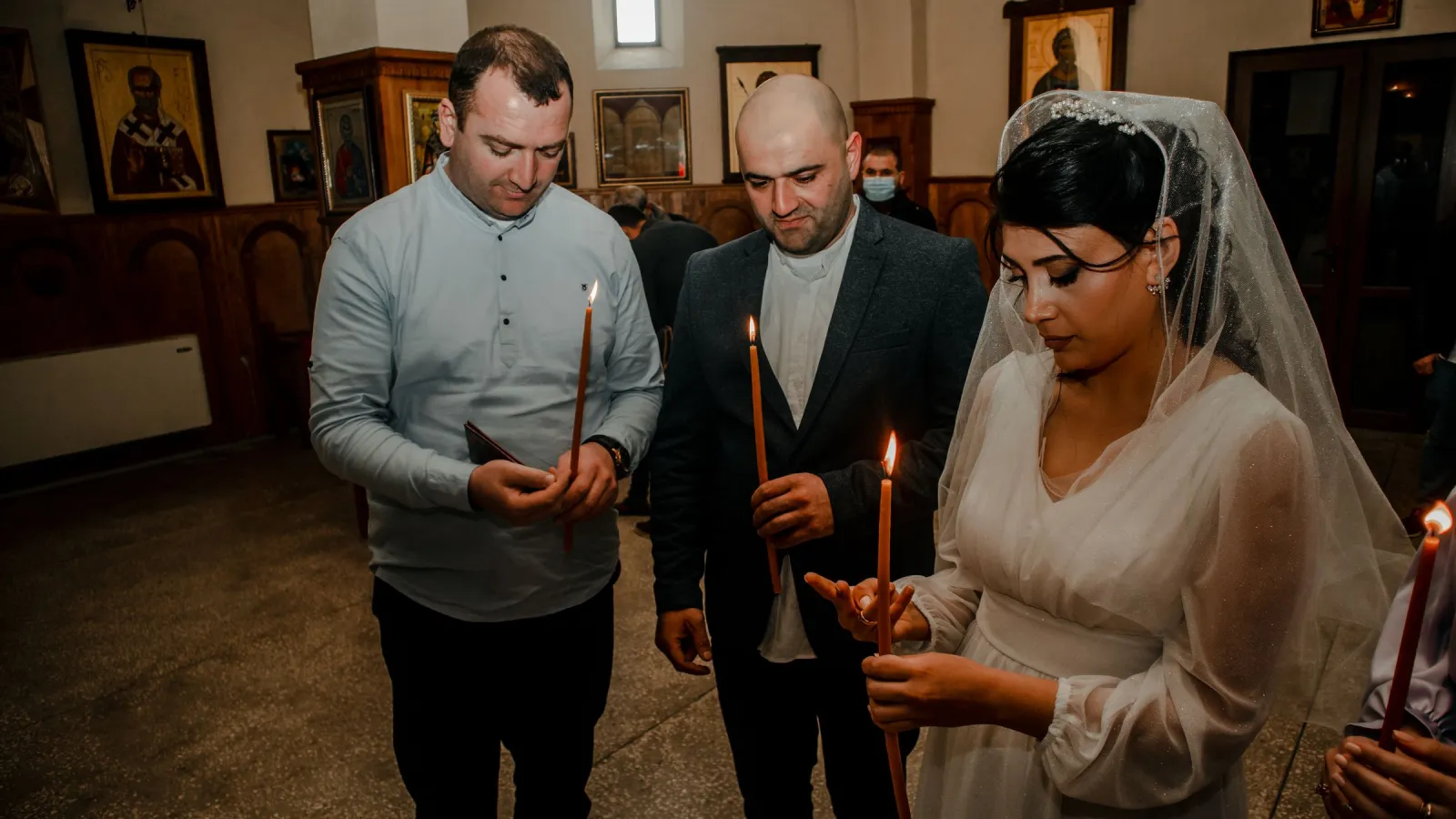
Quick answer
A Macedonian Orthodox church wedding needs a civil marriage already concluded or booked, baptism certificates for both partners, a baptised Orthodox kum and a talk with the parish priest. In the Skopje eparchy one priest costs 9,000 MKD (about 146 EUR). The kum traditionally buys the candles, and the church does not marry during the four fasts.
Key takeaways
- The registry office makes you married; the church requires that civil marriage to be concluded, or at least booked, before it crowns you.
- In the Skopje eparchy a wedding with one priest has cost 9,000 MKD (about 146 EUR) since June 2024; other eparchies set their own price lists.
- The wedding candles are traditionally the kum's purchase, and parishes often expect them to be bought at the church where you marry.
- The church does not marry during the four fasts; in 2027 that closes 15 March–1 May, 28 June–11 July, 14–27 August and the weeks from 28 November.
- A mixed marriage is possible only on conditions the priest and the eparchy set, so raise it at your very first meeting with the priest.
In this article
The church wedding is the part of a Macedonian wedding day that relatives care about most and couples usually know least about. The registry office makes the marriage legal; the Macedonian Orthodox Church – Ohrid Archbishopric (MOC-OA) crowns it, on its own terms and by its own calendar. This guide covers what the church asks for, what it costs, the wedding candles, the service step by step, and the dates when the church does not marry.
What does the Macedonian Orthodox Church require for a church wedding?
The Macedonian Orthodox Church requires a civil marriage that is already concluded, or at least a booked registry date, baptism certificates for both partners, a baptised Orthodox kum, and a conversation with the parish priest before your date is confirmed. Almost everything beyond that, from confession to what the kum brings, depends on the parish.
- The civil marriage comes first. A church wedding has no legal effect on its own, so the priest asks for your marriage certificate or a confirmed registry date. The registry side is covered in our guide to marriage documents in North Macedonia.
- Both partners are baptised. The standard case is two Orthodox Christians. If one of you is not, read the mixed-marriage section below first.
- A kum who is a baptised Orthodox Christian. The kum stands beside you during the service and signs as the witness of the religious act. The kuma is traditional too. Some parishes want to see the kum's baptism certificate.
- A conversation with the priest. Here you agree the date, the documents and the fee, and hear what this parish expects.
- Confession and communion, where practised. Some priests ask the couple to go to confession and communion before the wedding, and some celebrate the wedding within the Divine Liturgy, where the couple receives communion; a Macedonian text of that rite is published on Premin portal. Practice varies by parish.
- A previous marriage. If either of you was married in church before, raise it at the first meeting; the priest will tell you what the eparchy requires.
Which documents do you need, and where do you get them?
You need a baptism certificate (krshtenica) for each partner from the parish where you were baptised, proof of the civil marriage or its booked date from the registry office, and valid ID. Some parishes also ask for the kum's baptism certificate. Collect everything one to two months before the wedding, so a missing record does not become a crisis.
| Document | Where you get it | When |
|---|---|---|
| Bride's baptism certificate | The parish church where she was baptised, which keeps the baptism register | 1–2 months before the wedding |
| Groom's baptism certificate | The parish church where he was baptised | 1–2 months before the wedding |
| Marriage certificate extract, or confirmation of the registry booking | The registry office (UVMK) in the municipality where you marry | When you book the registry date, or right after the civil ceremony |
| Kum's baptism certificate (if the parish asks) | The kum's own parish | Together with yours |
| Valid ID card or passport for both partners | You already have it; check the expiry date | At the first meeting and on the day |
| For a non-Orthodox Christian partner: proof of baptism and a signed statement | Their own church for the baptism record; the statement is given before the Orthodox priest | Agree at the first meeting, months ahead |
| Written confirmation from your home parish (only if requested) | Your parish priest | When you book a church outside your parish |
If either of you was baptised abroad or long ago in a village church, start earlier: old registers take time to search.
Plan your wedding in one place
Guest list, budget, checklist and a free wedding website. Built for couples in North Macedonia.
Start for freeHow much does a church wedding cost in 2026?
In the Skopje eparchy, a wedding with one priest costs 9,000 MKD (about 146 EUR). That figure comes from a June 2024 report in the daily Večer, carried by Religija.mk, on the eparchy's new price list, which raised the fee from 6,000 MKD. A wedding with three priests costs more, and other eparchies set their own prices.
| Item | Amount | Status |
|---|---|---|
| Church fee, one priest, Skopje eparchy | 9,000 MKD (about 146 EUR) | Reported, applies from 1 June 2024 |
| Church fee, one priest, Skopje, before June 2024 | 6,000 MKD (about 98 EUR) | Reported, for comparison |
| Church fee, Bitola (Prespa-Pelagonia eparchy) | 7,700 MKD (about 125 EUR) | Reported in the same article |
| Wedding with three priests | More than with one priest | Amount not stated in the report |
| Plain wedding candles bought at the church | 300–900 MKD (5–15 EUR) for the pair | Editorial estimate |
| Decorated candles from a decorator | 1,500–3,500 MKD (24–57 EUR) for the pair | Editorial estimate; shops quote on request |
| Choir or chanter | Ask the parish | No public price list |
| Gift to the priest | Your choice | Voluntary, not a fee |
The figures were reported in 2024, so confirm the 2026 amount with your parish. Three things help the numbers make sense:
- The fee is a church fee, not the priest's pay. According to the MOC, part of it covers church taxes: every priest who officiates at a wedding, baptism or funeral pays a church tax, raised from 700 to 1,000 MKD, and the tax for liturgical literature rose from 300 to 500 MKD.
- Nobody is turned away for money. The MOC told the same outlet that a priest has no right to refuse someone who cannot pay, or can pay only part. Anything you give the priest personally is separate from the fee and voluntary.
- Who pays depends on the family. Macedonian wedding guides list the bride's father, the groom, the kum and the dever as the traditional payers of the church side, and many families simply split it. What the kum takes on is described in our guide to Macedonian wedding traditions.
Who buys the wedding candles, and what do they look like?
The wedding candles are traditionally the kum's purchase. They are a pair of tall white or ivory candles, lit during the service and held beside the couple. Parishes often expect the kum to buy them at the church where you marry, so check with the priest before you order decorated candles from a shop.
Macedonian wedding guides list the kum's church items as the candles, large towels, the pogacha bread, wine and the cloth used to bind the couple's hands; in some families the mother-in-law brings the bread, sweets and wine instead. A 2017 Skopje Info report went further and said the kumovi must buy the candles at the church where the couple marries, so put the question in your first call.
- The candle. Long, straight, white or ivory, sometimes beeswax, and much taller than the candles lit at the entrance, because they burn through the whole service.
- The decoration. Satin ribbon, lace, pearls, and small silk or dried flowers matched to the bouquet are the usual choices. Keep everything low on the candle, well away from the flame, and leave a clean stretch where the hand holds it.
- Who holds them. Depending on the parish, the couple holds the candles, or the kum and kuma hold them while standing beside the couple.
- Afterwards. Many couples take the candles home as a keepsake. Ask whether your parish has its own custom before the service.
To match the candles to the décor, give your florist the ribbon colour and the bouquet flowers; see our guide to wedding flowers and décor. Order decorated candles only once you know the parish accepts them; if the rule is to buy at the church, have the decorator dress those.
What happens during the service, step by step?
The wedding has two parts: the betrothal, when the rings are blessed and exchanged, and the crowning. Then come a reading from St Paul and the Gospel of the wedding at Cana, the common cup, the walk three times around the table to the hymn "Isaiah, rejoice", and the removal of the crowns. In our estimate it takes 30–45 minutes.
- The betrothal and the rings. The priest blesses the rings and the couple exchanges them as a pledge to one another.
- The candles. The wedding candles are lit and stay lit until the end of the service.
- The crowning. The priest places a crown on the groom, then on the bride, saying in Macedonian "Се венчава чедото Божјо…" ("The servant of God is crowned…") and then blesses them three times with "Lord our God, crown them with glory and honour." Ask whether the church provides the crowns or whether you need to bring anything.
- The readings. A reading from St Paul's Epistle to the Ephesians (5:20–33) and the Gospel of John (2:1–11), the wedding at Cana.
- The common cup. The couple drinks wine from one cup, three times each, as a sign that from now on they share everything.
- The walk around the table. The priest leads the couple three times around the table while three hymns are sung, starting with "Исаија ликувај" (Isaiah, rejoice), followed by "Holy martyrs" and "Glory to You, O Christ God". The kum and kuma follow. The couple's hands are often bound with the cloth the kumovi bring, and in some families the kuma scatters rice, oats, barley, sweets and coins in the church.
- The removal of the crowns. The priest lifts the crowns with a blessing for each of them ("Be magnified, O bridegroom, as Abraham…"), then gives the final blessing and the congratulations begin.
The crowns are commonly explained as the couple becoming king and queen of a new household, and as the martyrs' crowns, since married life asks for sacrifice; the circle around the table is read as their first steps together. A wedding within the Divine Liturgy takes noticeably longer. Either way, plan at least an hour for the church, including photos at the door.
When does the church not hold weddings in 2026 and 2027?
The Macedonian Orthodox Church does not marry during its four multi-day fasts: Great Lent with Holy Week, the Apostles' fast before Petrovden, the Dormition fast and the Christmas fast. The Church keeps the Julian calendar, so its fixed feasts fall 13 days later than in the Western calendar and the Easter-linked fasts move every year.
| Fast | 2026 | 2027 | Fixed or moving |
|---|---|---|---|
| Great Lent and Holy Week | 23 February – 11 April | 15 March – 1 May | Moves with Easter (12 April 2026, 2 May 2027) |
| Apostles' fast (before Petrovden, 12 July) | 8 June – 11 July | 28 June – 11 July | Start moves, always ends 11 July |
| Dormition fast (before Golema Bogorodica, 28 August) | 14 – 27 August | 14 – 27 August | Fixed |
| Christmas fast | 28 November 2026 – 6 January 2027 | 28 November 2027 – 6 January 2028 | Fixed |
The 2026 dates match the MOC's own fasting calendar; the 2027 ones follow from Orthodox Easter on 2 May 2027. Macedonian wedding guides put the rule simply: priests do not marry during the fasts, and practice can differ between eparchies. Also raise these with the priest:
- Wednesdays and Fridays. The MOC calendar marks them as fast days, apart from a few fast-free weeks. Many Orthodox churches do not marry on fast days, so ask before choosing a Friday.
- One-day fasts. 18 January (the eve of Vodici), 11 September (the Beheading of St John the Baptist) and 27 September (Krstovden) are marked as one-day fasts in the MOC calendar.
- Planning around summer. In 2026 the Apostles' fast closed most of June and early July. In 2027 it is short, only 28 June to 11 July, so May and most of June open up. The Dormition fast takes out the second half of August every year, right in the busiest part of the season.
Confirm the date with the priest before you pay a venue deposit.
Can an Orthodox Christian marry a Catholic, Muslim or non-religious partner in church?
Sometimes, and on conditions. For an Orthodox–Catholic couple, an MOC priest answering readers on Premin portal described a church prohibition that can be set aside if the Catholic partner signs a statement: not to hinder the Orthodox faith at home, and to have the children baptised Orthodox. For a partner who is not baptised, expect baptism to come up first.
The same answer is clear that the couple cannot be married in both a Catholic and an Orthodox rite, so if both families want a religious ceremony, talk to both priests before anyone books a church.
For a Muslim or non-religious partner, the Orthodox wedding is a sacrament of the Church, so expect the priest to raise baptism before anything else. Some mixed couples in North Macedonia keep the civil ceremony as the shared legal act and give each family's customs their own part of the day; our traditions guide has practical ideas for splitting traditions by time rather than forcing them into one moment. Whatever your situation, contact your eparchy early: it decides.
What should you wear, and can you photograph inside the church?
Dress as you would for a Sunday liturgy: covered shoulders and a modest neckline for women, no hats for men indoors, and nothing very short. If the bridal gown is strapless, plan a bolero, jacket or shawl for the church. Photography is usually allowed, but the priest sets the rules on movement, flash and the altar area.
A lace bolero or a long veil covers the shoulders without changing the look for the rest of the day; our wedding dress guide covers timing and fittings.
For photos and video, agree these points in advance:
- The altar area behind the iconostasis is not a place for photographers or guests.
- Ask whether flash is allowed; many historic churches have fragile frescoes and little light.
- Confirm where the videographer can stand and whether a small light or microphone is acceptable.
- Ask guests to keep phones down during the crowning; it is also the best shot of the day for your photographer.
Choose a photographer who has shot church weddings before; our guide to choosing a wedding photographer has the questions to ask.
How do you choose the church: your parish or somewhere else?
Start with your own parish: its priest keeps your baptism record, knows the families and is the simplest route. Marrying in another church, for example one near the venue or in a town that means something to you, is possible, but you then deal with two priests, so ask what your home parish needs to confirm and who will officiate.
Questions to ask any church before you commit:
- Does this church hold weddings, and on which days and times?
- Can our own parish priest officiate here, or is it always the local priest?
- Must the candles be bought here, and do you provide the crowns?
- Is there a choir or chanter, and what does it cost?
- Is there parking, and how far is it to the venue at our time of day?
A 40-minute drive between church and venue with 150 guests is a logistics problem, so look at both on one map; in the capital, our guide to wedding venues in Skopje helps.
Where do we start?
Do three things this week. First, choose two or three dates outside the fasts and call your parish priest before you pay any venue deposit. Second, book the registry office and ask both of you, and the kum, to request baptism certificates. Third, sit down with the kum and agree the candles, the church fee and who pays for what.
Then open your plan on Kazhida and add the church as a task with its own deadline, next to the registry office and the venue. When you need a photographer who knows church weddings or a decorator for the candles, browse vendors on Kazhida.
Sources
- Weddings, baptisms and funerals get more expensive (Skopje eparchy price list, 2024) – Religija.mk
- 15 minutes, amen and 100 euros: how much a church wedding costs – Skopje Info
- Wedding customs: who brings the candles and who makes the pogacha – Vo Belo
- On fasting: fast periods in the church calendar – Macedonian Orthodox Church – Ohrid Archbishopric
- Answers to your questions: marriage between an Orthodox and a Roman Catholic (Fr. Goran Taseski) – Premin Portal
- The wedding within the Holy Liturgy: the Macedonian text of the rite – Premin Portal
- Marriage in the Eastern Orthodox Church – Wikipedia
Frequently Asked Questions
How much does a church wedding cost in North Macedonia?
In the Skopje eparchy, a wedding with one priest costs 9,000 MKD (about 146 EUR), according to a 2024 report on the eparchy's new price list, up from 6,000 MKD. A wedding with three priests costs more. In Bitola, in the Prespa-Pelagonia eparchy, the reported fee was 7,700 MKD. Candles, a choir and any gift to the priest come on top, so confirm the full amount with your parish.
What documents do you need for an Orthodox church wedding in Macedonia?
Bring a baptism certificate for each partner from the parish where you were baptised, proof that the civil marriage is concluded or booked, and valid ID. The priest will also want to know who your kum is and that he is a baptised Orthodox Christian; some parishes ask for his baptism certificate too. Agree the exact list with the parish priest at your first meeting.
Who buys the wedding candles, and what happens to them afterwards?
Traditionally the kum buys the wedding candles, and parishes often expect them to be bought at the church where you marry. They are a pair of tall white or ivory candles, often dressed with ribbon, lace or small flowers. After the service many couples take them home as a keepsake, but ask the priest first, because parishes have their own habits about decorated candles.
When are church weddings not held in North Macedonia?
The Macedonian Orthodox Church does not marry during its four fasts: Great Lent with Holy Week, the Apostles' fast before Petrovden, the Dormition fast (14–27 August) and the Christmas fast (28 November–6 January). The Church follows the Julian calendar, so the Easter-linked fasts move every year. Wednesdays, Fridays and one-day fasts can also be a problem, so confirm your date with the priest first.
Can an Orthodox Christian marry a Catholic or a Muslim in a Macedonian church?
With a Catholic partner, a Macedonian Orthodox priest has described the wedding as possible on conditions: the Catholic partner signs a statement not to hinder the Orthodox faith at home and agrees that the children will be baptised Orthodox, and the couple cannot also marry in a Catholic rite. With a partner who is not baptised, expect the question of baptism to come first. The eparchy has the final word.
Can we take photos and video inside the church?
Usually yes, but the priest sets the rules. Photographers normally stay out of the altar area behind the iconostasis, avoid walking between the couple and the priest during the prayers, and ask before using flash. Small or frescoed churches limit movement and light even further. Introduce your photographer to the priest, or confirm the rules by phone, a week before the wedding.
Keep reading
Kum, Dever, Star Svat: Macedonian Wedding Party Roles
Who does what at a Macedonian wedding: what the dever, kum, kuma and star svat actually do on the day, who pays for what, and how to ask them.
· 13 min read
Macedonian Wedding Traditions: A 2026 Guide
Kum, star svat, dever, fetching the bride, the oro and the money gift — what each custom means, how the day runs and what is actually required.
· 10 min read

Wedding Catering in North Macedonia: 2026 Price Guide
Wedding catering in North Macedonia in 2026: published prices per guest, the hidden costs, how many waiters you need and how to check a caterer's registration.
· 14 min read